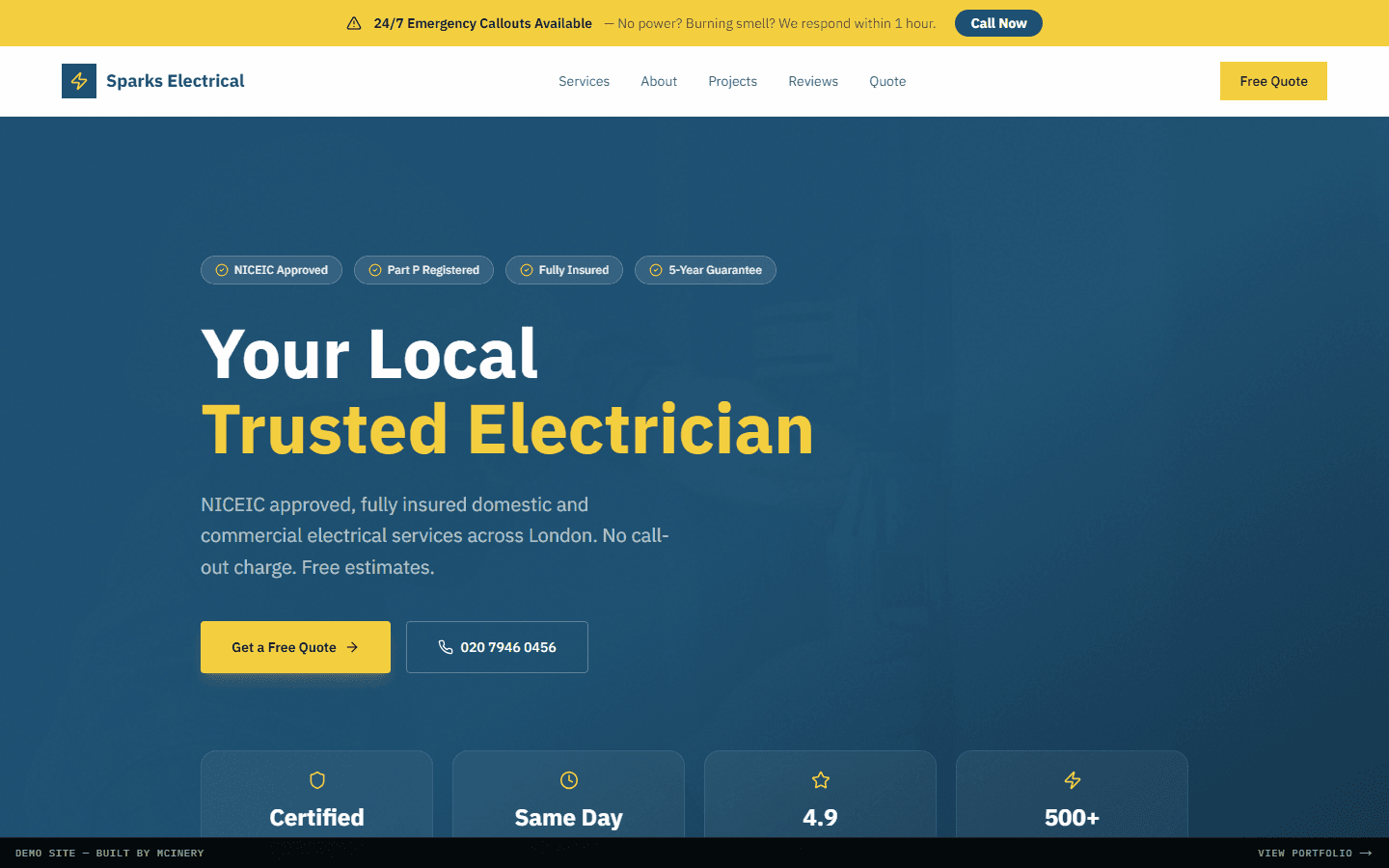
Most tradespeople rely on word-of-mouth and directory listings. Sparks Electrical — a NICEIC-approved electrician serving North and East London — needed a professional online presence that would instil confidence immediately and make it effortless for customers to request a quote. The site had to work as hard as the electrician does. Beyond just looking professional, it needed to actively generate leads — turning visitors who searched 'electrician near me' into paying customers.
Trust is Everything
When someone needs an electrician, they're letting a stranger into their home to work on something dangerous. The entire design centres on building trust before the visitor even picks up the phone. I researched what makes people choose one tradesperson over another and it consistently came back to three things: accreditations, reviews, and professionalism of presentation.
Accreditation badges (NICEIC, Part P, fully insured, 5-year guarantee) appear within the first scroll — not buried in a footer, but right in the hero section alongside the main headline. A Google review rating with real customer testimonials sits prominently on the homepage. The colour scheme — navy blue with yellow accents — was chosen deliberately: blue conveys reliability and professionalism, yellow adds energy and ties into the electrical theme naturally.
I also added a dedicated certifications section further down the page with larger badge-style cards explaining what each accreditation actually means. Most people don't know what NICEIC is — telling them it means the work is independently inspected and guaranteed builds far more confidence than just showing a logo.

The Emergency Callout Banner
Electrical emergencies don't wait for business hours. A bright yellow banner runs across the top of every page with '24/7 Emergency Callouts Available' and a direct call button. It's impossible to miss, and on mobile the phone number is a single tap to dial.
I debated whether this would feel too aggressive, but the data is clear — emergency work is the highest-margin service for electricians and customers in an emergency will call the first number they see. The banner uses `position: sticky` so it stays visible as you scroll, but collapses to a thinner strip after the first 200px to avoid dominating the page once the visitor starts reading.
The Quote Form
The site has one job: generate quote requests. Every design decision was made with this in mind. The quote form captures service type, urgency level, postcode, phone number, and a description — giving the electrician everything needed to respond with an accurate estimate without a follow-up call.
I added an urgency selector with three options: Standard, Urgent (within 48 hours), and Emergency (today). This does two things — it sets realistic expectations for the customer, and it helps the electrician triage incoming requests. Emergency requests trigger a different notification so they don't get lost in the queue.
A floating 'Call Now' button appears on mobile after scrolling past the hero. The phone number is clickable everywhere it appears — in the header, the hero, the footer, and the floating button. On desktop, the CTA is always visible in the navigation. These aren't design flourishes — they're conversion mechanics backed by the principle that every extra click you add loses a percentage of potential customers.
How It Works — The 3-Step Process
Trades websites often fail because they assume the customer knows how the process works. Most people have never hired an electrician directly — they don't know if they need to be home, whether they'll get a quote before work starts, or how payment works.
I added a prominent 'How It Works' section with three clear steps: Get in Touch, Free Quote, Job Done. Each step has an icon, a heading, and a one-sentence description. It's connected by a horizontal line on desktop that visually shows progression. This simple section addresses the anxiety that stops people from enquiring — it tells them exactly what happens after they hit 'Send' and makes the whole process feel manageable.
Service Clarity & SEO
One of the biggest problems with trades websites is vagueness. 'We do electrics' doesn't help anyone. Each service — rewiring, EV charger installation, fault finding, lighting design, testing and certification, commercial fit-outs — has its own card with a clear description and indicative pricing. I used specific Lucide icons for each service rather than generic electrical bolt icons, which helps differentiate them visually.
This serves two purposes: it qualifies leads (customers know roughly what to expect before enquiring) and it's excellent for SEO. Each service targets specific long-tail search terms like 'EV charger installation London' or 'EICR certificate Hackney'. The structured data markup includes each service as a `hasOfferCatalog` entry, helping Google understand and surface these in relevant searches.
I also added a 'Recent Projects' section with three project cards showing real work — a full house rewire, an EV charger installation, and a commercial lighting fit-out. Each card has a photo, a brief description, the location, and the timeline. This isn't just portfolio padding — it shows prospective customers that the electrician handles jobs like theirs, which is the final nudge many people need before making contact.
Reviews & Social Proof
I integrated customer reviews prominently — not hidden on a separate testimonials page, but woven into the homepage with star ratings, customer names, locations, and 'Verified Customer' badges. The reviews are presented in a card grid with enough detail to feel authentic without overwhelming the page.
The psychology here is straightforward: people trust other people more than they trust businesses. A five-star review from 'David M. in Islington' saying the work was clean and finished ahead of schedule carries more weight than any amount of marketing copy. I positioned the reviews section immediately after the services — at the exact point where a visitor is thinking 'but are they actually any good?'
Local SEO Foundation
For a local trades business, appearing in 'electrician near me' searches is make-or-break. The site was built with local SEO baked in from day one — LocalBusiness schema markup, service area coverage, location-specific meta tags, and semantic HTML throughout.
The service areas section lists sixteen London neighbourhoods in a visual grid — Islington, Hackney, Camden, Haringey, Stoke Newington, Shoreditch, and more. This helps both search engines and customers quickly confirm coverage. Each area name is a potential search term, and combined with the review testimonials and accreditation badges, the site projects exactly the right signals for local search ranking.
I also ensured the site loads fast on mobile — under 2 seconds on a 4G connection. Google's Core Web Vitals are a ranking factor, and trades searches are overwhelmingly mobile. A slow site loses the customer before they even see the phone number.